April 20, 2026, Digital Public Services on the Road to the EU: Tilting the Playing Field for Ukrainian Businesses and Its Social Costs. Lecturers: Dora Piroska (CEU) (Vienna); Ihor Moshenets (CEU Vienna/Vienna University of Economics and Business).
 The lecture examined the role of digital public services in Ukraine within the broader framework of its European Union integration trajectory. Professor Pisorska introduced a theoretical framework on GovTech by situating Ukrainian digitalization efforts within debates on state capacity and EU enlargement. Drawing on the work of Max Weber, Peter Evans, and Annalee Newitz, she critically assessed the limitations of neoliberal approaches to industrial policy, particularly in relation to the institutional preconditions required for effective digital governance.
Building on this conceptual foundation, Ihor Moshenets presented an empirical analysis of three flagship Ukrainian digital initiatives: ProZorro, Diia, and Diia City. These case studies illustrated how digital reforms have been shaped by the interaction of domestic policy priorities and international support mechanisms, while simultaneously constrained by political and economic factors.
The discussion further addressed the governance implications of digitalization, including concerns related to data protection, cybersecurity, and the ambivalent role of digital infrastructures in either reinforcing democratic accountability or enabling new modalities of state control. Student interventions focused on the tension between technological innovation and democratic norms, particularly with regard to data protection within platforms such as Diia and the alignment of Ukraine’s regulatory framework with EU acquis. Specific attention was devoted to regulatory instruments, including the 9% exit capital tax and the institutionalization of gig contracts, both of which raise complex questions in the context of regulatory harmonization with the European Union.
April 27, 2026, Agri-Food Sector – Between Market Access and Exclusion. Lecturers: Julia Langbein, Centre for East European and International Studies (ZOiS) (Berlin); Oleg Nivievskyi, Kyiv School of Economics (KSE)
 The lecture examined the integration of Ukraine’s agri-food sector into the European Union’s legal and market frameworks, with contributions from Dr. Julia Langbein (ZOiS) and Dr. Oleg Nivievskyi (KSE).
Julia Langbein, a Senior researcher at the Centre for East European and International Studies, approached the topic from a comparative political economy perspective. She analyzed divergent pathways of market integration in Poland, Romania, and Ukraine, focusing in particular on the dairy sector. Her analysis demonstrated how variations in institutional capacity, state support, and market structures have produced uneven integration outcomes. In the Ukrainian case, she identified key structural constraints, including high levels of sectoral fragmentation, limited institutional capacity, and the risk that small-scale producers may be marginalized or excluded from formalized supply chains in the course of regulatory alignment with EU standards.
Complementing this perspective, Oleg Nivievskyi, Associate Professor and Dean at the Kyiv School of Economics, provided a macroeconomic overview of Ukraine’s agricultural sector. He emphasized its centrality to the national economy, accounting for approximately 20% of GDP and a substantial share of exports. His analysis highlighted the complexities associated with EU accession, including persistent trade barriers, institutional and administrative constraints, and the prospective implications for the EU’s Common Agricultural Policy, particularly in terms of budgetary pressures.
The session concluded with a discussion of the infrastructural and institutional prerequisites for successful integration. Particular emphasis was placed on the need to develop “developmental coalitions” between state and market actors, underscoring the importance of coordinated policy frameworks, investment in logistics and standards compliance, and the strengthening of governance capacities to facilitate sustainable integration into the EU agri-food system.
May 4, 2026, Enhancing EU Connectivity In Times of War and Geopolitics. Lecturers: Iryna Kosse, Institute for Economic Research and Policy Consulting (IER), Kyiv; Mihai Varga, Institute of East European Studies, Free University Berlin (Berlin).
 This lecture examined the transformation of European connectivity against the backdrop of intensifying geopolitical tensions, with a particular focus on the fallout from Russia’s invasion of Ukraine.
The first speaker, Iryna Kosse, Leading Research Fellow at the Institute for Economic Research and Policy Consulting (IER) in Kyiv, will examine Ukraine’s transport connectivity with the EU under wartime conditions. Her talk will address the disruption of established trade and transport routes and the emergence of alternative corridors such as the “Solidarity Lanes”. She argues that wartime necessity has accelerated a longer-term structural realignment of Ukraine’s transport system toward Europe, but that significant infrastructure investment is still required to sustain and deepen this integration into EU networks.
The second speaker, PD Dr. Mihai Varga, Lecturer at the Institute for East European Studies at Freie Universität Berlin, takes a wider regional lens, tracing the evolution of transnational infrastructure projects across the Black Sea and Caspian regions, from Eastern Europe through the South Caucasus to Central Asia. Drawing on nine case studies, he argues that the countries involved are no longer mere transit corridors between great powers but have become strategic actors in their own right, shaping connectivity across the region.
Together, the two talks make the case that infrastructure policy has moved to the heart of Europe’s geopolitical future: decisions about routes, standards, and investments are no longer merely technical matters but define the contours of political alignment, economic integration, and regional resilience for years to come.
May 11, 2026. IFIs and Development Banks in the Enlargement Process. Ukraine Facility. Lecturers: Matthias Thiemann (Sciences Po, Paris) and Maria Repko (Centre for Economic Strategy, Kyiv)
 The ADVANCE-EUiUA Jean Monnet Module continues with a timely and important session on “IFIs and Development Banks in the Enlargement Process. Ukraine Investment Facility”!Matthias Thiemann (Sciences Po, Paris) and Maria Repko (Centre for Economic Strategy, Kyiv) bring complementary perspectives to one of the most consequential questions in Ukraine’s EU accession journey: how are international financial institutions and development banks shaping the path to integration — and at what cost?
Matthias Thiemann’s recent research (published in JEPP) traces the rise of the European Enlargement State, pointing to a new institutional architecture in which the European Commission, the EIB, the EBRD, and national development banks like KfW coordinate investment flows into candidate countries through blended finance. While this machinery delivers scale, it also raises critical questions about domestic ownership, bankability logic, and whether it can deliver for a country navigating war and reconstruction simultaneously.
Maria Repko offers a ground-level view from Ukraine itself: why IFI financing is flowing more slowly than needed, what bottlenecks Ukrainian businesses and municipalities actually face, and what reforms — on both sides — are urgently required.
Together, they paint a full picture of the promise and the pitfalls of the Ukraine Investment Framework.
Watch the recording of the lecture:
May 18, 2026. Ukraine’s Critical Minerals Potential & EU Strategic Autonomy. Lecturers: Luuk Schmitz (Senior Researcher, Max Planck Institute for the Study of Societies (MPIfG); Ielyzaveta Badanova (Researcher, Department of Law, European University)
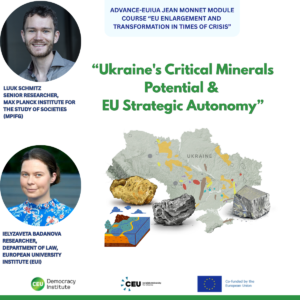 The lecture explored how Ukraine’s vast reserves of critical minerals, hydrocarbons, and agricultural resources have become central not only to the war’s geopolitical dynamics, but also to Europe’s long-term economic security and strategic autonomy.
Drawing on current debates in EU trade and industrial policy, the speakers addressed how Ukraine’s resource sovereignty intersects with Europe’s ambitions for energy diversification, green transition technologies, and economic security amid intensifying global competition.
June 1, 2026, Accession as Transformation: EU Finance, Conditionality, and Local Governance Capacity in Ukraine. Lecturers: Inna Melnykovska, Jean Monnet Fellow, Robert Schuman Centre for Advanced Studies, European University Institute (EUI); Anna Kornyliuk, Associate Professor, Ukrainian Catholic University (UCU)
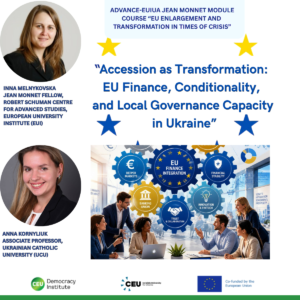 This lecture examined how international financial flows to Ukrainian municipalities are split between shock response and long-term modernisation and what that balance reveals about the real pace and politics of Ukraine’s EU integration addressing such timely question as: ‘How long-term finance supports modernisation and innovation and builds the institutions and governance capacity Ukraine needs for EU accession?’
June 8, 2026, The Integration of Ukraine and EU’s Future. Lecturers: Veronica Anghel, Assistant Professor, Robert Schuman Centre for Advanced Studies, European University Institute (EUI); Erik Jones, Director, Robert Schuman Centre for Advanced Studies, European University Institute (EUI)
 This lecture brought together two scholars who have been at the forefront of the debate on how Ukraine is integrating into the EU under wartime conditions and whether enlargement will happen following a fast pace. Erik Jones and Veronica Anghel are dedicated to translating lessons from past enlargements and analysis of contemporary geopolitics into policy recommendations for Ukraine’s accession. Their recent work argues that the EU has evolved from a club generating exclusive benefits for members into a system of common-pool resources, one whose access can no longer easily be refused to outsiders. Veronica Anghel further argued that enlargement is the EU’s prime relational geopolitical strategy, binding security to markets, institutions, and publics, and making it inseparable from the question of what kind of power the EU wants to be.