Course: EU Enlargement and Transformation in Times of Crisis: Lessons Learned from Pre- and Post-Experiences in Eastern Europe and the Western Balkans
Course Directors: Inna Melnykovska, European University Institute and
Laszlo Bruszt, CEU Democracy Institute
Preliminary syllabus
Course description:
The European Union’s renewed commitment to enlargement marks a decisive moment in the reconfiguration of Europe’s political order. Triggered by Russia’s full-scale invasion of Ukraine, the EU’s decision to advance accession processes with Ukraine, Moldova, and the Western Balkans has reopened fundamental scholarly and policy questions: Can enlargement still function as a transformative instrument under conditions of geopolitical rivalries, war and democratic backsliding? How do emergency-driven, ad hoc instruments reshape the Union’s established enlargement logic, and what are the implications for EU internal reforms?
This research seminar invites participants to engage critically with the evolving political economy and governance of EU enlargement. Building comparative insights from previous waves in Central and Eastern Europe and ongoing processes in the Western Balkans, participants will explore how conventional tools – conditionality, benchmarking, acquis adoption – are increasingly complemented or substituted by context-specific mechanisms such as phased integration, reconstruction-linked assistance, and security-oriented pre-accession frameworks.
Key themes include:
- The theoretical rethinking of enlargement as a process of mutual transformation between the EU and candidate states;
- The interaction between geopolitical pressures, institutional constraints, and normative commitments in shaping enlargement strategies;
- The political economy of EU support for wartime and post-war reconstruction in Ukraine;
- The interplay between enlargement and internal EU reforms, including decision-making, budgetary solidarity, and rule-of-law mechanisms;
- The comparative experiences of the Western Balkans and Eastern Partnership countries as laboratories for policy innovation and institutional adaptation.
The seminar emphasizes research design and methodological pluralism. Students will develop and present their own research projects addressing contemporary policy challenges, drawing on both qualitative and quantitative approaches, from process tracing and discourse analysis to network and institutional modeling. Interventions from EU policymakers and practitioners will complement academic discussions, linking theoretical inquiry to real-world governance dilemmas.
Learning outcomes:
By the end of the seminar, participants will have advanced their capacity to formulate original research questions, situate them within broader scholarly debates on European integration, and contribute empirically grounded insights into how enlargement is redefining the EU’s identity, boundaries, and global role in times of crisis.
Learning activities and teaching formats:
The seminar combines thematic lectures, research-focused discussion seminars, and a summer school with policymakers and scholars. This structure allows students to engage with both theoretical debates and applied policy perspectives, encouraging dialogue between academic research and practice.
This course begins with two components: lectures and seminars. Lectures will be given by the course directors, scholars participating in the Enlargement Hub and other invited guest speakers from the EU and Ukraine, who are usually experts or practitioners in the topic of the week. Lectures will be interactive, involving round-table conversations with the guests and discussions with students. The seminars’ main goals will be to discuss the concepts, arguments, follow-up questions, etc. brought up in the lectures and critically reflect on the reading(s) assigned for the week. To facilitate participation, students are requested to cover core English-language readings before seminars. A larger selection of readings is offered, covering topics from the perspectives of political science, political economy, and law.
The course finishes with the summer school taking place at the CEU Democracy Institute in Budapest and online. The summer school will give participants the opportunity to present and receive feedback on their research projects (proposal, chapter or paper) from senior scholars in their fields; as well as improve their methodological, writing, etc. skills.
Overview of lectures – for summaries and recordings, please click here
- March 30, 2026, The Challenges of Studying Ukraine’s EU Integration. Lecturers: Laszlo Bruszt (CEU Democracy Institute); Ivan Nagornyak (NGO Easybusiness, Ukraine) – Find out more
- April 20, 2026, Digital Public Services on the Road to the EU: Tilting the Playing Field for Ukrainian Businesses and Its Social Costs. Lecturers: Dora Piroska (CEU) (Vienna); Ihor Moshenets (CEU Vienna/Vienna University of Economics and Business). – Find out more
- April 27, 2026, Agri-Food Sector – Between Market Access and Exclusion. Lecturers: Julia Langbein, Centre for East European and International Studies (ZOiS) (Berlin); Oleg Nivievskyi, Kyiv School of Economics (KSE). – Find out more
- May 4, 2026, Enhancing EU Connectivity In Times of War and Geopolitics. Lecturers: Iryna Kosse, Institute for Economic Research and Policy Consulting (IER), Kyiv; Mihai Varga, Institute of East European Studies, Free University Berlin (Berlin). – Find out more
- May 11, 2026. IFIs and Development Banks in the Enlargement Process. Ukraine Facility. Lecturers: Matthias Thiemann (Sciences Po, Paris) and Maria Repko (Centre for Economic Strategy, Kyiv). – Find out more
- May 18, 2026, Ukraine’s Critical Minerals Potential & EU Strategic Autonomy. Lecturers: Luuk Schmitz, Senior Researcher, Max Planck Institute for the Study of Societies (MPIfG); Ielyzaveta Badanova, Researcher, Department of Law, European University – Find out more
- June 1, 2026, Accession as Transformation: EU Finance, Conditionality, and Local Governance Capacity in Ukraine. Lecturers: Inna Melnykovska, Jean Monnet Fellow, Robert Schuman Centre for Advanced Studies, European University Institute (EUI); Anna Kornyliuk, Associate Professor, Ukrainian Catholic University (UCU) – Find out more
- June 8, 2026, The Integration of Ukraine and EU’s Future. Lecturers: Veronica Anghel, Assistant Professor, Robert Schuman Centre for Advanced Studies, European University Institute (EUI); Erik Jones, Director, Robert Schuman Centre for Advanced Studies, European University Institute (EUI) – Find out more
Overview of Seminars (preliminary)
- April 23, 2026, Drivers and Obstacles in Europeanization: Contrasting Theoretical Approaches; by Inna Melnykovska, European University Institute
- April 28, 2026, Concepts and Concept Building in EU integration and enlargement research; by Inna Melnykovska, European University Institute
- May 14, 2026, Grasping EU Effects: Methods and Data; by Inna Melnykovska, European University Institute
Summer School
Planned for July 2026 in a hybrid mode at the CEU Democracy Institute in Budapest. More information to follow.
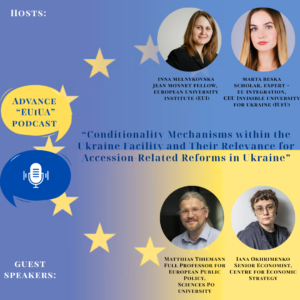

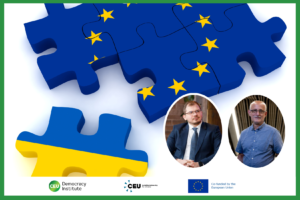

 EU Integration Dialogues: The Ukraine Edition is a podcast series dedicated to debates on EU enlargement, differentiated integration, and Ukraine’s path toward EU accession. It is a product of the ADVANCE EUiUA project, aimed at disseminating knowledge about lessons learned from past EU enlargements and addressing political dynamics within EU institutions, member and partner states, and their relationships with accession countries, focusing on Ukraine. Hosted by Inna Melnykovska (European University Institute, EUI) and Marta Beska (CEU Invisible University for Ukraine, IUFU).